

Transcranial Magnetic Stimulation uses targeted magnetic pulses—similar in strength to those used in MRI imaging—to stimulate specific areas of the brain involved in mood regulation, emotional processing, and the systems that drive symptoms of depression, OCD, anxiety, and other conditions. The magnetic pulses pass painlessly through the skull and induce small electrical currents in the underlying brain tissue, which over the course of treatment helps restore the activity of brain circuits that have become underactive in mental health conditions.
Unlike medication, TMS doesn’t work by changing brain chemistry through drugs that affect the whole body. It works locally, on specific brain circuits, with no systemic effects—no weight gain, no sexual side effects, no fatigue, no cognitive blunting, no daily medication to remember. For many patients, this is the difference between treatment they can sustain and treatment they end up stopping.
TMS has been studied for more than 40 years and has gained significant clinical traction in the past decade. It is one of the most extensively researched mental health treatments available, with strong evidence for its safety and effectiveness in depression specifically and growing evidence for other conditions. Serenity Mental Health Centers considers TMS our signature treatment—it’s the option we reach for most often when traditional approaches haven’t been enough.
TMS is most established for major depressive disorder, with growing applications across other mental health conditions:
Major Depressive Disorder (MDD). This is the primary FDA-approved indication and the most extensively studied use of TMS. TMS is particularly valuable for patients with treatment-resistant depression—those who haven’t responded fully to one or more antidepressant medications—and for patients who can’t tolerate medication side effects. It’s also FDA-approved for depression with anxious distress, which is one of the most common patterns we see.
Obsessive-Compulsive Disorder (OCD). TMS is FDA-approved for OCD using a specific protocol that targets brain circuits involved in obsessive thoughts and compulsive behaviors. For patients with OCD who haven’t responded fully to SSRIs and exposure-and-response-prevention therapy, TMS provides a meaningful additional option.
Anxiety disorders. While not separately FDA-approved for generalized anxiety disorder, TMS shows meaningful benefit for anxiety symptoms, particularly when anxiety co-occurs with depression. The FDA-approved indication for “depression with anxious distress” addresses one of the most common clinical presentations: patients whose depression and anxiety are intertwined.
Post-Traumatic Stress Disorder (PTSD). Growing clinical evidence supports TMS for PTSD, particularly in veterans and patients with treatment-resistant trauma symptoms. The Department of Veterans Affairs has incorporated TMS into VA mental health care for some patients, including through the Michael E. DeBakey VA Medical Center in the Texas Medical Center. For Houstonians whose PTSD relates to combat service, first responder work, intimate partner violence, hurricane experiences, or other sources, TMS can be a meaningful complement to trauma-focused therapy and medication.
Other conditions. TMS is also used for smoking cessation (a specific FDA-approved indication), bipolar depression (under appropriate care), and other conditions where standard treatments haven’t been adequate. Whether TMS is right for your specific situation is a conversation we have during evaluation.
For most patients, TMS is much less involved than they expect. Here’s what happens:
You arrive and sit down. Sessions take place in a comfortable chair, similar to a dental chair, in our Upper Kirby office. You don’t change clothes, you don’t get an IV, you don’t take any medication, and you don’t need anyone to drive you.
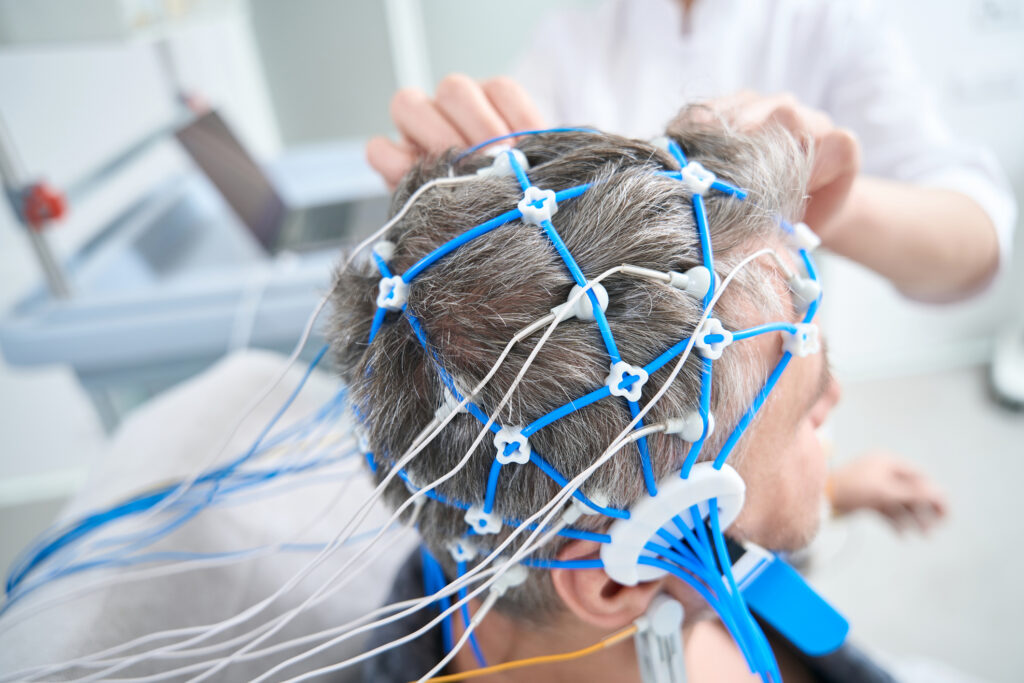
The coil is positioned. A magnetic coil is positioned against the side of your head, targeting specific brain areas based on your diagnosis and treatment protocol. Initial mapping during your first session determines the exact placement and intensity, and after that, the placement is consistent session to session.
Treatment begins. Brief magnetic pulses are delivered through the coil. You’ll feel a tapping sensation at the treatment site—most patients describe it as similar to someone tapping on the side of your head with a pencil. Some patients find this mildly uncomfortable in the first session or two, and most adjust quickly. Treatment cycles between pulses and rest periods over the course of the session.
You’re awake and aware the whole time. Patients can read, watch something on a phone or tablet, listen to music, or just rest. There’s no sedation, no altered mental state, no fog. Many patients use the time to catch up on email, prepare for rounds, or watch a show.
Sessions typically last 19 to 37 minutes depending on the protocol for your condition. The newest TMS protocols are at the shorter end of that range; older protocols are at the longer end.
You leave and go about your day. No recovery time, no driving restrictions, no work restrictions. You can drive yourself back across the loop to TMC for clinic, return to a Galleria office, head home to The Woodlands or Sugar Land, or whatever your day involves.
A standard course of TMS involves daily sessions (Monday through Friday) over 4 to 6 weeks—typically 30 to 36 sessions total. This is the most significant practical consideration with TMS, and it’s worth being honest about: daily clinic visits for over a month is a real commitment, especially in a metro the size of Houston where commutes can be substantial.
Why it works this way. The treatment effect builds with repeated sessions over time. The brain circuits TMS targets need repeated stimulation to shift toward a more typical activity pattern, and the treatment course is designed to deliver enough stimulation to produce durable change. Shorter courses don’t work as well.
What patients typically notice during the course. Most patients begin to notice some improvement in the second or third week, though some notice changes earlier and some later. Sleep often improves first. Mood and energy typically follow. The full benefit of treatment is usually clear by the end of the standard course.
Scheduling. We schedule sessions to fit around clinical schedules, energy-sector shifts, family commitments, and the other realities of Houston life. Sessions can be early morning (we open at 6:00 AM)—useful for TMC clinicians coming in before rounds—during long lunch breaks, or late afternoon and evening (we’re open until 9:00 PM weekdays). Our Upper Kirby location is minutes from TMC, the Galleria, and downtown, and accessible from across Greater Houston.
Gulf Coast hurricane season scheduling. Hurricane evacuations and major storm closures occasionally affect daily session scheduling between June and November. We work with patients on the practical realities—rescheduling around named storms, building in flexibility when storm paths are uncertain, and making up sessions as needed once conditions are safe. The treatment course can absorb a few weather-related reschedules without significantly affecting outcomes.
After the initial course. Some patients respond well to the initial course and don’t need further TMS for an extended period. Others benefit from periodic maintenance sessions—every few weeks or months—to sustain the gains. The pattern that works best for you becomes clear over time, and we adjust accordingly.
Our Houston location serves a patient population whose work, lives, and accumulated stresses are shaped by realities specific to this metro. Several reasons TMS often fits well:
Treatment that doesn’t show up on prescription records. Houston is home to one of the world’s largest concentrations of healthcare professionals across TMC, and to substantial populations of energy industry professionals, first responders, military service members, and other workers whose careers involve credentialing, licensing, fitness-for-duty considerations, or simply a preference for keeping mental health care off pharmacy records. TMS sidesteps these concerns entirely. Treatment is in-clinic, ends when the course ends, and doesn’t generate the pharmacy data that some patients prefer to avoid.
Treatment that doesn’t interfere with demanding clinical or operational work. Antidepressants commonly cause fatigue, cognitive blunting, weight gain, sexual side effects, and emotional flattening—all of which can affect the work of physicians, surgeons, nurses, EMTs, plant operators, engineers, and others in cognitively demanding or operationally critical roles. TMS doesn’t cause any of those effects, so treatment supports work rather than competing with it.
Treatment for accumulated trauma. Houston has lived through multiple catastrophic events in recent years—Harvey in 2017, the February 2021 freeze, Beryl in 2024, and other storms and disruptions in between. For patients whose depression or PTSD has built across these recurring exposures, TMS can be a meaningful option, particularly when medication and therapy alone haven’t been enough.
Treatment for treatment-resistant depression. The largest TMS patient population is people who’ve tried multiple antidepressants without sustained relief. About a third of depression patients don’t respond fully to the first medication tried, and many cycle through two, three, or more before finding (or not finding) sustained benefit. For these patients, TMS represents a fundamentally different mechanism—not another pill, but a different approach to the underlying brain circuit dysfunction.
Treatment for new mothers preserving breastfeeding. Postpartum depression is common, and many new mothers want to avoid antidepressants while breastfeeding. TMS doesn’t involve any systemic medication, doesn’t pass to the baby, and is compatible with breastfeeding throughout the treatment course.
Treatment for older adults on multiple medications. Many of our older patients are already on multiple prescriptions for medical conditions. Adding an antidepressant introduces drug-drug interaction risks. TMS sidesteps that concern entirely because it isn’t a drug, and it’s well-tolerated in older adults.
Treatment that takes the metro into account. Houston is a sprawling metro, and a daily 4-6 week treatment commitment requires logistical planning. Our Upper Kirby location is among the most centrally accessible psychiatric clinics in the metro—minutes from TMC, River Oaks, Montrose, the Galleria, and the Heights, with direct access via the West Loop and US-59. For shift workers, our 6:00 AM to 9:00 PM weekday hours mean sessions can fit before or after shifts rather than competing with them.
Welcoming, multilingual care. Houston is one of the most diverse cities in the country. We provide care that is respectful of the cultural contexts patients bring with them and make therapy referrals in Spanish, Vietnamese, or other languages when we can.
The Texas Medical Center is the world’s largest medical complex, with more than 100,000 employees across Memorial Hermann, Houston Methodist, MD Anderson, Texas Children’s, Ben Taub, the VA, and training programs through Baylor College of Medicine, UTHealth, and others. Depression, anxiety, and PTSD are common in this workforce—often underdiagnosed and undertreated because of specific barriers to care that affect clinicians. TMS often fits this population particularly well:
No prescription records or pharmacy data. Many clinicians delay or avoid seeking treatment for depression because of concerns about prescription records appearing in pharmacy benefit data, credentialing documentation, or future licensing applications. The reality is that treatment for depression generally does not affect medical licensure or credentialing, and mental health treatment records are protected by HIPAA—but the concern is real and persistent. TMS sidesteps it entirely. There’s no prescription, no pharmacy fill, no medication record in benefit data.
No side effects affecting clinical work. Antidepressants commonly cause fatigue, cognitive blunting, sexual side effects, and weight gain. For physicians, surgeons, nurses, and trainees whose work depends on sharp cognition, sustained attention, and physical stamina, these side effects can be career-affecting. TMS doesn’t cause any of them. Many of our TMC patients describe TMS as the first treatment that helped them feel better without compromising the work that defines their identity.
Treatment that fits clinical schedules. Our 6:00 AM start time fits before TMC morning rounds. Our 9:00 PM weekday closure fits after long clinical days. TMS sessions take 19-37 minutes, which can fit into a clinical schedule in ways that traditional therapy sessions sometimes can’t.
Trainees specifically. Medical students, residents, and fellows often hit clinical depression during training—the volume, the loss of autonomy, the cumulative sleep debt, the moral weight of certain rotations, and the financial stress of training all contribute. TMS during training can be a more sustainable option than antidepressants for trainees concerned about how psychiatric medication might appear in residency applications, fellowship matching, or future credentialing.
Treatment for clinicians caring for the dying. MD Anderson, the broader oncology community, palliative care, hospice, and ICU clinicians work with serious illness and death in ways that produce real cumulative grief and trauma. For clinicians whose depression or trauma relates to this dimension of clinical work, TMS can be part of recovery that doesn’t pull them out of work they care about.
Beyond healthcare, Houston has substantial populations of first responders, veterans, and energy and industrial workers whose work environments and accumulated exposures make TMS particularly useful:
First responders. Houston Fire Department, Houston Police, Harris County Sheriff’s Office, the surrounding suburban departments, and Houston-area EMS all have populations carrying accumulated trauma and depression. Many first responders avoid antidepressants because of concerns about cognitive effects, sedation, or fitness-for-duty considerations. TMS doesn’t impair cognition or alertness, doesn’t cause sedation, and is delivered before or after shift without any duty-day implications.
Veterans. Houston has a substantial veteran population served in part by the Michael E. DeBakey VA Medical Center in the TMC—one of the largest VA medical centers in the country. TMS has growing evidence for PTSD and treatment-resistant depression in veterans, and is part of VA mental health care for some patients. We accept Tricare and work with veterans who want specialty TMS care alongside or in place of VA services. Many of our veteran patients have tried VA medication management and want to add TMS to their care.
Energy industry and refinery workers. Houston’s energy industry and Ship Channel refineries employ a workforce that often does demanding physical or operational work, sometimes in safety-critical roles where medication side effects matter. TMS sidesteps the concerns about controlled substances and drug-testing that can affect this workforce, and the absence of cognitive or alertness effects keeps treatment compatible with operational responsibilities.
TMS and medication aren’t competing options—they’re different tools that serve different patient situations, and many patients use both at different points in their treatment. A few key differences:
How they work. Medications work by changing the balance of neurotransmitters throughout the brain (and the body—which is where side effects come from). TMS works locally on specific brain circuits, stimulating activity in regions that have become underactive in mental health conditions. The result is improvement without systemic effects.
Time to effect. Antidepressants typically take 4-8 weeks to show full effect, and patients often don’t know during those weeks whether the medication is going to work. TMS produces gradual improvement during the treatment course, and patients can often feel changes by week 2 or 3.
Side effects. Medication side effects are common and often disabling enough that patients stop treatment before it’s had time to help. TMS side effects are minimal—occasional headache or scalp discomfort during sessions, both of which typically resolve quickly.
Duration of effect. Antidepressants work only as long as you take them daily. TMS produces effects that last beyond the treatment course—often months or longer—and some patients maintain remission for extended periods with occasional maintenance sessions or no additional treatment.
Combining them. Many patients do well on a combination—continuing medication during and after TMS. Some patients eventually taper medication after TMS produces a strong response. These decisions are individualized.
Some patients ask whether TMS is similar to electroconvulsive therapy (ECT). They’re related in concept—both use forms of brain stimulation for treatment-resistant depression—but the experience is very different:
ECT involves general anesthesia, induces a brief therapeutic seizure, typically requires inpatient or outpatient hospital-based delivery with significant recovery time after each session, can produce temporary memory effects, and is reserved for the most severe or treatment-resistant cases. ECT is highly effective for severe depression and remains a valuable treatment in the right circumstances.
TMS is fully outpatient, involves no sedation or seizure induction, has no memory effects, lets you drive yourself home, and is appropriate for many patients who wouldn’t be candidates for ECT or who want to try a less invasive option first. Most patients trying brain stimulation for the first time appropriately start with TMS.
TMS is appropriate for most adults with depression, OCD, anxiety, or PTSD who haven’t fully responded to standard treatments, who want to avoid medication, or who can’t tolerate medication side effects. Specific considerations:
Established diagnosis. A clear diagnosis of one of the conditions TMS treats. We confirm this through our standard evaluation process before recommending TMS.
Prior treatment history. Insurance typically requires documentation of one or more (often two or more) antidepressant medication trials that haven’t worked adequately. Some patients qualify on a first-line basis based on intolerance to medication; others qualify after a treatment history.
No contraindications. The primary contraindications to TMS are metal implants in or near the head (cochlear implants, deep brain stimulators, aneurysm clips, certain dental implants—we assess this carefully) and a history of seizure disorder or significantly elevated seizure risk. Many patients with metal elsewhere in the body, including hip and knee replacements, are fine candidates.
Treatment commitment. The 4-6 week daily session course is the main practical commitment, and we want patients who are ready to engage with it. We work with patients on scheduling, but the time investment is real.
TMS is one of the better-tolerated treatments in psychiatry. Most patients have minimal side effects, and the side effects that do occur are typically mild and temporary:
Common (most patients). Mild headache during or after the session, mild scalp discomfort at the treatment site, brief facial twitching during pulses (the pulses can stimulate nearby facial muscles). These typically resolve within minutes to hours and become less noticeable over the course of treatment.
Less common. Lightheadedness during sessions, mild jaw discomfort if the pulses affect the masseter muscle. These typically resolve with minor coil position adjustments.
Rare. Seizure during treatment is the most serious potential side effect, occurring in well under 1 in 10,000 sessions in patients without seizure risk factors. We screen carefully for seizure risk before treatment and monitor during sessions.
What TMS doesn’t cause. Weight gain. Sexual side effects. Sedation or fatigue. Cognitive blunting. Sleep disturbance. GI issues. Memory problems. Dependency. None of the side effects that drive patients to stop antidepressants are TMS side effects, because TMS isn’t a drug.

Most major insurance plans cover TMS for treatment-resistant depression, and coverage has expanded substantially over the past decade. Plans we work with that typically cover TMS include Aetna, Blue Cross Blue Shield, Cigna, Optum, United Healthcare, Tricare, Medicare, Wellpoint, and many others. Coverage details vary—some plans cover TMS only for depression, others cover OCD and additional indications—and we verify your specific coverage during the consultation process.
Prior authorization. Insurance plans typically require prior authorization for TMS, which involves documentation of your prior treatment history, current diagnosis, and medical necessity. We handle the prior authorization paperwork on your behalf as part of getting started. This typically takes 1-3 weeks, depending on the insurance company.
What patients usually pay. With insurance coverage in place, patients are typically responsible for their plan’s standard cost-sharing—deductibles, copays, or coinsurance—rather than the full cost of treatment. We walk through the financial picture during consultation so there are no surprises.
Living on the upper Gulf Coast creates some specific conditions that interact with TMS treatment:
Heat, humidity, and medication storage. Houston summer heat affects medication storage (many psychiatric medications shouldn’t be left in hot cars), affects sleep quality (poor sleep blunts medication response), and adds another daily logistical challenge for patients on antidepressants. TMS sidesteps all of this.
Hurricane season disruption. June through November, hurricane preparation, evacuation, and recovery occasionally disrupt scheduling. We build flexibility into the treatment course and reschedule sessions as needed when storms affect the metro. The treatment course can absorb storm-related reschedules without significantly affecting outcomes.
Year-round outdoor recovery in the cooler months. Houston’s mild months—November through March—offer good conditions for the outdoor activity and physical movement that complement TMS treatment. Buffalo Bayou, Hermann Park, Memorial Park, and the broader bayou trail system support the kind of movement that supports mental health recovery.
Starting TMS isn’t a same-day decision. Here’s how the process typically unfolds:
Initial consultation. A thorough evaluation that includes review of your diagnosis, current symptoms, prior treatment history, and goals. We assess whether TMS is likely to help your specific situation and answer your questions about what treatment involves.
Screening for contraindications. Review of medical history for metal implants, seizure risk factors, and other considerations that affect TMS candidacy. Most patients clear this screening without issue.
Insurance authorization. Our team submits the prior authorization paperwork to your insurance company. This typically takes 1-3 weeks. We handle this; you don’t.
Treatment planning and scheduling. Once authorization is in place, we schedule your first session and the rest of the course. Sessions are scheduled to fit your actual schedule—early morning before rounds, midday between cases, late afternoon after shift, or whatever your week looks like.
First session and mapping. The first session takes longer (typically 60-90 minutes) because it includes initial mapping to determine optimal coil placement and intensity for you specifically. After that, sessions are at the standard 19-to-37-minute duration.
Treatment course and follow-up. Daily sessions Monday through Friday for 4-6 weeks. Periodic check-ins to track progress and adjust as needed. End-of-course evaluation and planning for what comes next—whether maintenance sessions, continued medication or therapy, or simply ongoing monitoring.
TMS is most effective when delivered as part of comprehensive psychiatric care, not as a standalone procedure. Our approach integrates TMS with medication management, therapy referrals, and ongoing clinical follow-up. We assess whether co-occurring conditions—anxiety, ADHD, sleep disorders, substance use, medical conditions—are affecting outcomes, and we adjust the broader plan as needed. For patients who prefer therapy referrals in Spanish, Vietnamese, or another language, we make those when we can.
Many patients arrive at TMS after years of feeling stuck on medication or after multiple unsuccessful trials. Our goal isn’t just to deliver TMS sessions; it’s to help patients build a sustainable approach to their mental health that works after the initial course ends.
Our Houston clinic is led by a board-certified psychiatrist with training in mood, anxiety, and related conditions:
Dr. Muhammad Atif Akhtar, MD — Board-certified Psychiatrist. View profile.
Our Houston team takes a patient-first, evidence-based approach: careful evaluation, transparent conversations about what TMS can and can’t do, and a steady pace that respects how you’re actually doing. With same-week consultations, extended hours, Tricare accepted, and TMS delivered on-site in Upper Kirby just minutes from TMC, we’re committed to making this signature treatment genuinely accessible in a city where access is often the hardest part.
TMS is fundamentally an in-person treatment—it can’t be delivered remotely. That makes location matter. Our Houston clinic is at 3355 West Alabama Street, Suite 1100, in Upper Kirby just inside the West Loop and minutes from the Texas Medical Center, River Oaks, Montrose, Greenway Plaza, and the Galleria. Patients coming from across Greater Houston—The Heights, West University, Bellaire, Katy, Sugar Land, The Woodlands, Pearland—can typically reach us without the cross-town haul that defines so much of Houston life. That proximity matters when you’re coming five days a week for several weeks.
Related Videos
Related Posts

When anxiety becomes a daily shadow instead of an occasional
Post-traumatic stress disorder (PTSD) can make daily life feel like
If you’re living with ongoing depression, you’ve likely explored many