

Ketamine is a medication that has been used safely as an anesthetic in medical settings for more than fifty years. Over the last two decades, research has shown that ketamine, at doses far lower than those used for anesthesia, produces rapid and meaningful antidepressant effects in patients with treatment-resistant depression, severe anxiety, PTSD, and acute suicidal ideation. It works through a different mechanism than traditional antidepressants, which is why it can help people who haven’t responded to SSRIs or SNRIs.
How ketamine works in the brain. Most antidepressants act on the serotonin or norepinephrine systems. Ketamine works on the NMDA receptor and the glutamate system, a fundamentally different pathway. The current understanding is that ketamine drives rapid changes in synaptic connectivity, the way brain cells communicate, and that this appears to underlie its fast antidepressant effect. It’s why ketamine can produce improvement within hours when standard antidepressants take weeks.
Not an opioid. One of the most common questions patients ask is whether ketamine is an opioid. It isn’t. Ketamine is a dissociative anesthetic, specifically an NMDA receptor antagonist. It doesn’t produce the dependence pattern associated with opioids, and it doesn’t carry the same overdose risk profile when it’s given in a clinical setting. The recreational misuse that occasionally makes headlines involves uncontrolled, unmonitored use, which is very different from medically supervised infusion therapy.
Why ketamine therapy exists. Standard treatments help many people, but about a third of depression patients don’t respond fully to the first medication tried, and many cycle through several medications without lasting benefit. For those patients, and for patients in active distress where conventional antidepressants are too slow, ketamine offers a different option with a different mechanism and a different timeline.
Ketamine therapy is most established for a handful of specific conditions:
Treatment-resistant depression. This is the primary use. “Treatment-resistant” usually means depression that hasn’t responded fully to one or more antidepressants tried at adequate doses for adequate durations. For these patients, ketamine offers a fundamentally different mechanism and can produce a response when other treatments haven’t.
Acute suicidal ideation. Ketamine has one of the most distinctive features in psychiatry: a rapid reduction in suicidal thoughts, often within hours. For patients in a suicidal crisis who can be safely managed as outpatients, ketamine can provide fast relief while longer-term treatment is established. It is not a replacement for emergency care during an acute crisis; if you’re in immediate danger, call 988 or go to your nearest emergency room.
Post-traumatic stress disorder (PTSD). Growing evidence supports ketamine for treatment-resistant PTSD, particularly in veterans, service members, first responders, and patients with severe trauma symptoms that haven’t fully responded to standard treatment. Whether the trauma relates to combat, frontline emergency work, an assault, or another source, ketamine can be a meaningful additional option within a broader treatment plan.
Severe anxiety. Ketamine shows benefit for severe or treatment-resistant anxiety, especially when it co-occurs with depression. Patients with disabling anxiety who haven’t responded to SSRIs, SNRIs, or benzodiazepines may benefit.
Addiction and substance use disorders. Ketamine has shown promise for certain substance use disorders, particularly alcohol use disorder, when it’s integrated with broader addiction treatment. This is an evolving area of practice.
Whether ketamine is right for your specific situation is a conversation we have during evaluation.
Many people looking into ketamine have heard of it but don’t know what to expect. Here’s what actually happens:
You arrive at the clinic. Sessions take place in a private, comfortable treatment room. We usually suggest eating lightly beforehand and avoiding a heavy meal right before treatment. You can bring a book, headphones, an eye mask, or anything else that helps you settle in.
You meet the nurse who administers your infusion. An experienced registered nurse places the IV, reviews your vitals, and goes over the plan for the session. We monitor blood pressure, heart rate, and oxygen throughout.
The infusion begins. Ketamine is delivered slowly through the IV over about 40 minutes. The dose is well below what’s used for surgical anesthesia, calibrated for a therapeutic effect, not unconsciousness. You stay awake and able to communicate the whole time.
What it feels like. Most patients move into a mild to moderate dissociative state during the infusion. That can include feeling detached from the body, time distortion, heightened senses (colors, music, or images feeling unusually vivid), or a sense of observing your own thoughts and feelings from the outside. Some describe it as relaxing or even profound, some find it uncomfortable but tolerable, and few find it overwhelming when the dose is right. The dissociation itself appears tied to the antidepressant effect, so it isn’t a side effect to endure so much as part of how ketamine seems to work.
The infusion ends. Once the ketamine stops, the dissociative effects fade over the next 15 to 30 minutes. You rest in the treatment room until you’re ready to leave, usually about an hour later. Most sessions run about two hours start to finish.
You’re driven home. You cannot drive yourself home after an infusion. You need a trusted person available to drive you. We may be able to help arrange a rideshare, but planning ahead matters.
The rest of your day. Most patients feel tired, mildly groggy, or quiet for the remainder of the day. By the next morning most feel back to normal, and many notice the antidepressant effect by then.
A standard course of ketamine therapy for depression usually involves about six infusion sessions, typically scheduled twice a week over the first two to three weeks. After the initial course, some patients benefit from periodic maintenance infusions, anywhere from every few weeks to every few months, to hold the response. Others don’t need more infusions and instead move to maintenance approaches like medication, therapy, or TMS.
Why six sessions. A single infusion can produce noticeable improvement within hours, but the effect of one infusion usually lasts only days to weeks. The repeated sessions of the initial course are designed to build a more sustained response, and patients who complete the full course generally hold their benefit longer than those who do single sessions.
What patients tend to notice during the course. Many notice improvement after the first infusion, often within 24 hours. Sleep frequently shifts early. Mood and energy usually follow. Patients with active suicidal thoughts often report fast relief from the most intense of them. The full benefit is usually clear by the end of the standard course.
Planning around work and duty schedules. For patients with fixed commitments, drill weekends, rotating shifts, travel, or a fitness-for-duty timeline, we can time the course around them. The six-session course typically completes in two to three weeks, short enough to fit most planning windows.
After the initial course. The duration of response varies a lot between people. Some hold their benefit for months without more treatment, some need periodic maintenance infusions, and some transition to other treatments to sustain what ketamine produced. We build the maintenance plan around your response and your situation.
Concerns about privacy come up often, and they carry extra weight for patients with professional licenses, hospital credentialing, employer-sponsored benefits, or a security clearance. A few honest points:
HIPAA protects your records. Mental health treatment records are protected by HIPAA, and we do not share information with employers, licensing bodies, agencies, or anyone else without your written authorization. The clinical record stays with us and you.
Ketamine leaves a lighter paper trail than daily medication. Because it’s given in-clinic, ketamine involves no pharmacy fill and no ongoing controlled-substance prescription that follows you through pharmacy benefit data. It’s a defined course with a clear endpoint, after which you’re not on an ongoing medication. For clinicians worried about DEA registrations and credentialing, and for cleared defense workers, that difference can matter.
Clearance, in brief. Mental health treatment generally does not disqualify a security clearance, and the federal government has explicitly encouraged personnel to seek care. For how the current standards apply to your specific situation, we recommend consulting your security officer, an EAP, or an attorney familiar with clearance law.
Discretion in practice. Our extended hours let appointments fit before or after work without requiring explanations for an absence, and we handle care with the privacy patients expect.
Arizona has one of the largest veteran and military-retiree populations in the country, and a great many settle in the East Valley. The region also runs on defense and aerospace work, most visibly the Boeing plant at Falcon Field that builds AH-64 Apache helicopters, and it’s home to National Guard and reserve members and Luke Air Force Base personnel who live out this way. Ketamine has both real advantages and specific constraints for these patients, worth naming directly:
No prescription record on fitness-for-duty matters. Antidepressants sometimes require disclosure in fitness-for-duty evaluations, flight physicals, and other military-specific medical reviews. The disclosure isn’t usually disqualifying, but the requirement creates real stress in certain career tracks. Ketamine doesn’t generate the medication record that triggers those disclosures.
No daily medication side effects between sessions. Antidepressants commonly cause fatigue, cognitive slowing, sexual side effects, or weight gain, any of which can affect performance. Between ketamine sessions there are no medication side effects to manage.
The operational constraint. The honest tradeoff: you cannot be on duty, on a shift, in a safety-sensitive role, on call, or driving the day of an infusion. The dissociative effects during and right after treatment make those activities unsafe for that day. We schedule sessions on protected non-duty days, around drill weekends, or during leave. Most patients work this out, but it takes planning, and we cover it during consultation.
Tricare coverage. We accept Tricare for evaluation, medication management, and TMS therapy. IV ketamine infusions, however, are generally not covered by Tricare and are primarily cash-pay. For patients who need treatment-resistant depression care that insurance covers, TMS is the better-covered route.
Coordination with the VA and military medicine. For patients already receiving care through the Phoenix VA Health Care System or another facility, we can coordinate alongside those services. Ketamine is often used to complement, not replace, existing mental health care, and service-branch or unit-specific guidance is worth checking; we can talk it through during consultation.
Beyond veterans and the defense workforce, several patterns we see often in our Mesa patients benefit from ketamine:
Treatment-resistant depression after multiple medications. This is the largest ketamine population. East Valley patients who have worked through SSRIs from primary care, then second-line agents, and still haven’t found relief have an option that works through an entirely different mechanism.
Active suicidal ideation that can be safely treated outpatient. Ketamine’s rapid reduction in suicidal thoughts is its most distinctive clinical feature. For patients in significant distress who don’t require inpatient care, it can provide fast relief while longer-term treatment is put in place. Anyone in immediate danger should call 988 or go to an emergency room first; ketamine is outpatient care that works alongside, not instead of, emergency services.
Healthcare workers with treatment-resistant depression. Nurses, techs, EMTs, and clinical staff at Banner Desert, Banner Baywood, Mountain Vista Medical Center, Cardon Children’s, and the wider East Valley systems often have concerns about prescription records, credentialing, and DEA registrations that make ketamine appealing. Treatment is in-clinic and doesn’t appear in pharmacy data.
Veterans. For veterans whose treatment-resistant depression or PTSD hasn’t fully responded to VA medication management or trauma-focused therapy, ketamine offers a different mechanism with growing evidence in veteran populations. We accept Tricare and VA Community Care for evaluation and TMS; ketamine infusions specifically are cash-pay.
First responders. Mesa Fire and Medical, Mesa PD, the Maricopa County Sheriff’s Office, and the surrounding departments all include personnel carrying accumulated trauma. Ketamine has growing evidence for treatment-resistant PTSD in first responders.
Older adults with treatment-resistant depression. Late-life depression is common in the East Valley’s large retiree community, and for older adults already on several prescriptions, a treatment that adds no daily medication can be appealing. Ketamine candidacy in older adults calls for careful cardiovascular screening, which is part of our evaluation.
Aerospace, semiconductor, and manufacturing professionals. The technical workforce across the Falcon Field and Gateway corridor and the region’s growing chip and manufacturing sector includes patients whose depression has resisted standard treatment and who value a finite, in-clinic course over ongoing medication.
Patients who need relief faster than antidepressants provide. SSRIs and SNRIs typically take four to eight weeks to reach full effect. For patients on a worsening trajectory or against a tight timeline, ketamine’s rapid onset matters.
Patients who haven’t responded to TMS. Many patients try TMS first because insurance covers it, and most respond well. For those who don’t, ketamine represents a different mechanism that may help.
We want to address this head-on because it matters: IV ketamine infusion therapy is generally not covered by most insurance plans, including most commercial plans, Tricare, VA Community Care, Medicare, and most others. That makes ketamine primarily a cash-pay treatment, and the cost is real.
Why coverage is limited. Although ketamine has been used safely as an anesthetic for more than fifty years, the FDA has not separately approved IV ketamine for depression. (Spravato, an esketamine nasal spray, is a related but different formulation that is FDA-approved and insurance-covered, with its own separate requirements.) The lack of FDA approval for IV ketamine specifically means most plans don’t cover the infusions, even when they cover other treatments for the same condition.
What patients typically pay. Costs vary by treatment plan and number of sessions. We walk through the full financial picture during consultation, including the total cost of the initial six-session course and any anticipated maintenance, so there are no surprises.
If cost is a barrier. For patients who would benefit from rapid-acting treatment but for whom ketamine isn’t financially realistic, TMS therapy is an alternative that most plans cover, including Tricare and VA Community Care. TMS works through a different mechanism but reaches many of the same patients (treatment-resistant depression, OCD, PTSD). We discuss both during consultation and recommend the path that fits your situation, not the most expensive one.
Honest framing. Some patients value ketamine enough to invest in it; others find the cost makes it impractical regardless of clinical fit. Both are reasonable, and we don’t push patients toward ketamine when another option might serve them well.
Ketamine, given in a controlled clinical setting with appropriate monitoring, has a strong safety record. The most common side effects:
During the infusion. Dissociation (detachment, time distortion, sensory effects) is expected and part of the treatment experience. Other in-session effects can include mild nausea, dizziness, a temporary rise in blood pressure or heart rate, and feeling sleepy. These are monitored continuously by the nurse.
Right after the infusion. Grogginess, mild fatigue, and lingering mild dissociation can persist for an hour or so. Most patients are ready to leave about an hour after the infusion ends.
Later that day. Tiredness, quietness, and occasionally a transient lift in mood. Most patients feel back to baseline by the following morning.
Less common. Headache, more pronounced nausea, vivid dreams the night after treatment, and rarely a temporary increase in anxiety the next day. Most of these resolve quickly and are manageable with supportive care.
Long-term considerations. Long-term, high-frequency, unmonitored ketamine use, the kind seen in recreational misuse rather than clinical care, has been linked to bladder problems and cognitive effects. Therapeutic ketamine given in a clinical setting at appropriate doses and intervals has a very different and far more favorable safety profile, and we monitor for any concerning patterns across the course.
Contraindications. Ketamine is generally not appropriate for patients with active psychosis or schizophrenia, uncontrolled high blood pressure, certain cardiovascular conditions, certain liver conditions, or active substance use disorders involving dissociative substances. We screen carefully during evaluation.
Ketamine therapy is appropriate for adults with significant depression, PTSD, anxiety, or related conditions that haven’t responded fully to standard treatments. Specific considerations:
Established diagnosis. A clear diagnosis of a condition for which ketamine is appropriate, which we confirm through our standard evaluation before recommending it.
Prior treatment history. Ketamine is typically reserved for patients who haven’t responded to at least one or two standard treatments, with some exceptions, particularly for patients with rapid clinical needs or specific intolerances to standard medications.
Medical screening. Pre-treatment evaluation reviews cardiovascular history, blood pressure, current medications (including anything that could interact), and other conditions affecting candidacy. Most patients clear this screening, but some with specific medical conditions are not candidates.
Reliable transportation plan. Because you can’t drive yourself afterward, you need a dependable way home. This is non-negotiable for safety.
Financial considerations. Because IV ketamine is generally not insurance-covered, patients need to weigh the cost realistically before starting. We walk through this transparently.
Treatment integration. Ketamine works best as part of broader psychiatric care, not as a standalone treatment. Patients should be willing to engage with therapy, medication management, or other supports as part of the overall plan.
Ketamine isn’t the only option, and it isn’t always the best one. A few comparisons:
Ketamine and antidepressant medication. Antidepressants work gradually (four to eight weeks to full effect), require daily dosing, are usually insurance-covered, and produce systemic effects including possible side effects. Ketamine works rapidly (hours to days), comes as a series of in-clinic sessions, is generally not insurance-covered, and produces a time-limited dissociative experience during sessions. For patients who can wait for medication to work and tolerate its side effects, medication is often first-line. For patients who can’t wait, haven’t responded, or can’t tolerate the side effects, ketamine is a meaningful alternative.
Ketamine and TMS. Both treat treatment-resistant depression, but through very different mechanisms and experiences. TMS is a brain-stimulation treatment (no medication, no dissociation), delivered daily over four to six weeks, generally insurance-covered (including by Tricare and VA Community Care), with no driving restrictions and minimal side effects. Ketamine works faster and needs fewer sessions (two to three weeks) but isn’t insurance-covered, requires a driver home, and produces a dissociative experience during treatment. Many patients suit one or the other; some suit both. We discuss which fits your situation.
Ketamine and ECT. ECT remains an important treatment for severe and treatment-resistant depression, particularly in the most severe cases. It involves general anesthesia and induced seizures, usually in a hospital setting with meaningful recovery time. Ketamine is far less invasive and generally suited to somewhat less severe presentations. Patients who haven’t responded to ketamine and TMS sometimes do well with ECT.
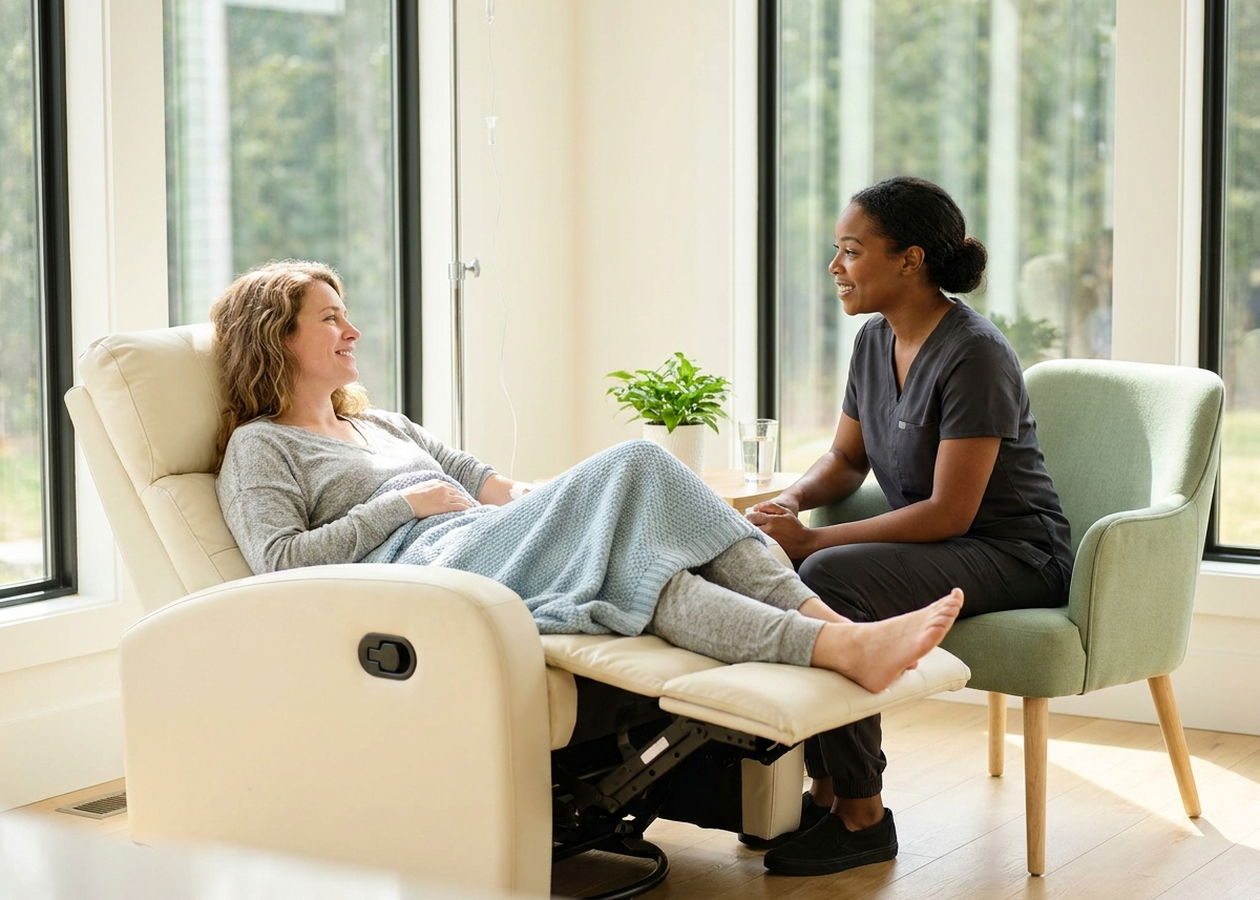
Starting ketamine therapy isn’t a same-day decision. Here’s how it usually unfolds:
Initial consultation. A thorough evaluation covering your diagnosis, current symptoms, prior treatment history, medical history, and goals. We assess whether ketamine is likely to help your specific situation and answer your questions about what treatment involves, including the cost, the driver-home requirement, and the dissociative experience. If you have credentialing, licensing, clearance, or duty-status considerations, this is a good time to ask what you’ve been carrying.
Medical screening. Review of cardiovascular history, blood pressure, medications, and other conditions to confirm ketamine is safe for you specifically.
Financial planning. A direct conversation about the cost of treatment and what your specific course is likely to involve. We don’t move forward until you understand the financial picture.
Treatment scheduling. Once you decide to proceed, we schedule your sessions around your work hours, shift or duty cycles, family commitments, and East Valley commute.
Treatment course and follow-up. Typically six sessions over two to three weeks, with check-ins to track your response, an end-of-course evaluation, and a plan for what comes next, whether maintenance infusions, continued medication or therapy, a transition to TMS, or ongoing monitoring.
Ketamine therapy is most effective as part of comprehensive psychiatric care, not a standalone procedure. Our approach folds ketamine together with medication management, therapy referrals, and ongoing clinical follow-up. We assess whether co-occurring conditions, anxiety, ADHD, sleep disorders, substance use, medical issues, are affecting outcomes, and we adjust the broader plan as needed.
Many patients arrive at ketamine after years of feeling stuck. The goal isn’t just to deliver infusions; it’s to help you build a sustainable approach to your mental health that holds after the initial course ends.
Our Mesa clinic is staffed by board-certified psychiatric providers with experience treating mood, anxiety, PTSD, and related conditions, supported by experienced registered nurses who administer the infusions:
Dr. Bryan DeFelice works with patients across mood and trauma-related conditions, with an emphasis on accurate diagnosis and a plan adjusted over time based on how you’re actually responding.
Dr. Neil Wilkey treats depression, PTSD, and severe anxiety with a whole-person view that weighs both the neurology and the life around it.
Both providers share a patient-first, evidence-based approach: careful evaluation, honest conversation about what ketamine can and can’t do, straight talk about cost and alternatives, and a steady pace that respects how you’re actually doing. With same-week consultations, extended hours, Tricare and VA Community Care accepted (for evaluation, medication management, and TMS, not for ketamine infusions, which are generally cash-pay), ketamine delivered on-site in the Riverview district, and the discretion professional life often requires, we’re set on making this treatment fit the way our patients actually live.
If you or someone you love is in a mental health crisis, immediate help is available:
988 Suicide & Crisis Lifeline. Call or text 988 for free, confidential support 24/7.
Veterans Crisis Line. Call 988 then press 1, or text 838255.
911 or your nearest emergency room. For immediate danger.
Ketamine therapy is an outpatient treatment that requires evaluation, planning, and follow-through. It’s a meaningful option for many patients, but it is not a substitute for emergency care during an acute crisis.
Our clinic is at 2046 Riverview Auto Drive, Suite 401, Mesa, AZ 85201, in the Riverview district where the Loop 101 meets the Loop 202. Ketamine therapy is delivered on-site by experienced clinical staff. We’re a short drive from Downtown Mesa, Tempe, Chandler, and Gilbert, and an easy reach for patients in Scottsdale, Queen Creek, and Apache Junction, as well as the Boeing Falcon Field and Gateway aerospace corridor.
IV ketamine therapy is most established for treatment-resistant depression, meaning depression that hasn’t responded fully to one or more antidepressant medications, and for treatment-resistant or severe PTSD. It’s also used for severe anxiety, certain addiction conditions, and patients with acute suicidal ideation, where ketamine’s rapid onset, often within hours, is particularly valuable. It’s generally reserved for situations where standard treatments haven’t been enough.
Ketamine has a privacy advantage over daily medication: because it’s given in-clinic, there’s no pharmacy fill and no ongoing controlled-substance prescription that follows you, which matters to patients with credentialing, licensing, or clearance concerns. Mental health treatment records are protected by HIPAA, and we don’t share information with employers, licensing bodies, or anyone else without your written authorization. Mental health treatment generally does not disqualify a security clearance, and the federal government has encouraged personnel to seek care; for specifics, we recommend consulting your security officer, an EAP, or an attorney familiar with clearance law.
Yes. Arizona has one of the country’s larger veteran populations, and we work with veterans, National Guard and reserve members, and the defense workforce across the East Valley. We accept Tricare for evaluation, medication management, and TMS, and coordinate with the Phoenix VA Health Care System, though IV ketamine infusions themselves are generally cash-pay. One operational note: you cannot be on duty, on a shift, in a safety-sensitive role, or driving the day of an infusion, so we plan the course around duty cycles, drill weekends, and work schedules.
You’ll receive ketamine through an IV in a comfortable, monitored setting. The infusion itself takes about 40 minutes, and most sessions wrap up within two hours including the rest period afterward. During the infusion, most patients experience a mild to moderate dissociative state, a sense of being detached from the body, time distortion, and sensory effects. Those effects subside within an hour after the infusion ends. You’re monitored throughout by an experienced registered nurse, and you must arrange for someone to drive you home; you cannot drive yourself.
We want to be straight about this: IV ketamine infusion therapy is generally not covered by most insurance plans, including most commercial plans, Tricare, VA Community Care, Medicare, and most others. That makes it primarily a cash-pay treatment. Costs vary by treatment plan, and we walk through the full financial picture during consultation so there are no surprises. It’s a valuable treatment for the right patient, but the cost is real and should factor into your decision. For patients who need treatment-resistant depression care that insurance covers, TMS therapy is an alternative most plans, including Tricare, do cover.
Yes. You cannot drive yourself home after a ketamine infusion. The dissociative and sedative effects mean you need a trusted person to drive you, and we typically recommend having someone with you for the rest of the day. For patients without easy local support, this takes planning. Options include a colleague, a friend, or a rideshare (we can help arrange). We talk through the driver question during consultation and don’t move forward until it’s solved.
Extremely educated about Ketamine therapy. My depression symptoms improved, despite the exorbitant cost.
C.F.
Google
Extremely educated about Ketamine therapy. My depression symptoms improved, despite the exorbitant cost.
R.H.
Google
Dr. Clay has given me my life, family, and friends back to me. When I first started seeing Dr. Clay, I was so depressed and anxious that I didn’t go out of the house. Dr. Clay’s medical assistant on my first appointment told me that he would never give up on me and he never has. Flash forward to now, and I’m seeing my friends, family, going out to run errands on my own, and even going to see my beloved sister in Colorado March 1st with our daughter. I am SO thankful for Dr. Clay and his team at Serenity Mental Health. They are a huge blessing and I feel so lucky to have found them!
k.
Google
My psychiatrist is named Dr. Colvin and he is an excellent person to count on for aid with mental health. He has prescribed medicine for me that has worked wonders in my life, and he continues to meet my concerns by providing more medication when needed. Alongside him, the staff is extremely flexible with their availability, and whenever I’ve needed to change a date on the calendar for appointments, they have been swift and generous to meet those needs as well. I’d recommend Serenity to anyone that is struggling to battle the demons in their head; they have changed my life and I know they will do the same for you as well.
K.D.
Google
Tolulope’s experience with TMS therapy has been excellent. She is patient and really kind, even if the initial consultation took some time to schedule.
M.V.
Google
Related Videos
Related Posts

Ketamine therapy is rapidly transforming the landscape of mental health

Ketamine therapy has gained traction as one of the most

Traditional medications can feel like a long, uncertain path for