


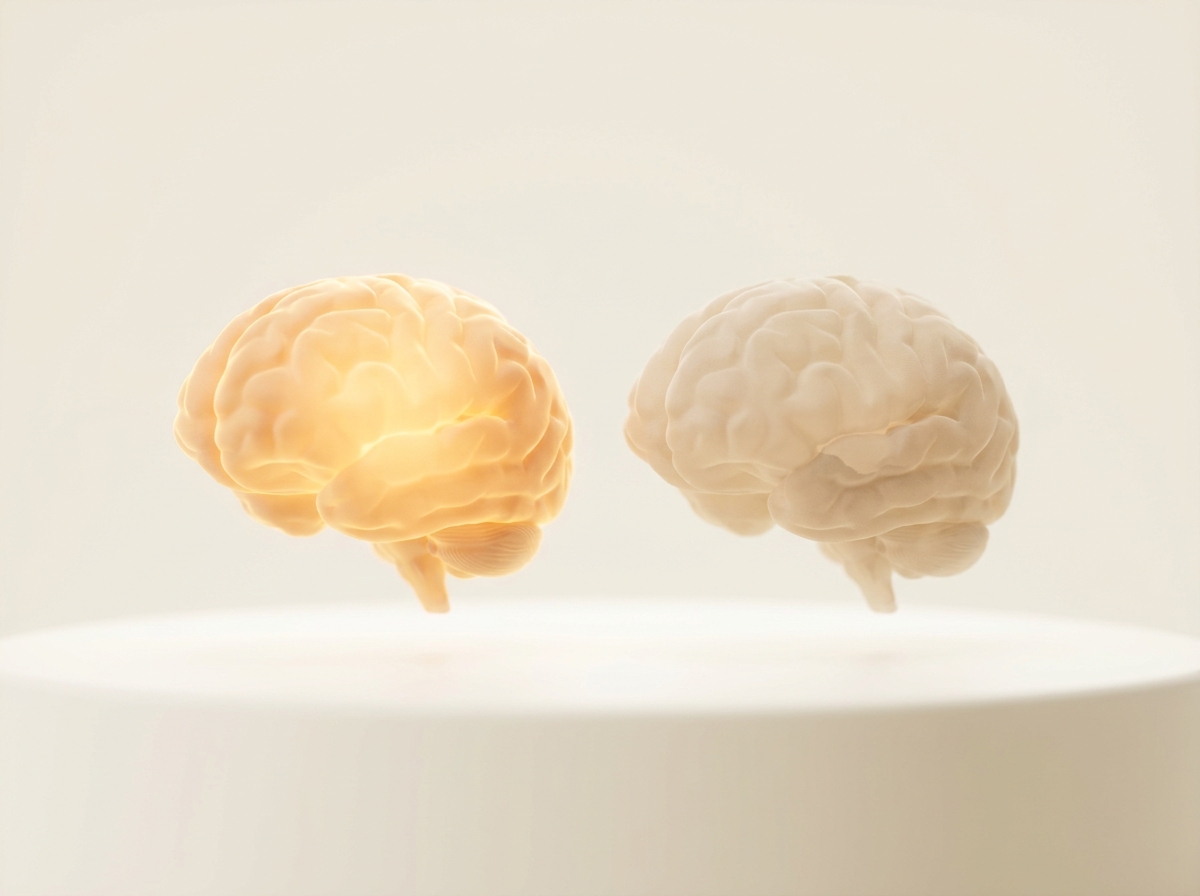
Patients sometimes ask me whether years of depression, anxiety, or chronic stress have permanently aged or damaged their brain. I understand why that question carries so much fear.
The research offers a more hopeful and more complicated answer. Scientists can estimate a person’s “brain age” from MRI patterns, and those estimates are associated with health, cognition, and lifestyle factors. But brain age is not the same as a birthday, a diagnosis, or a prediction of exactly what will happen to one individual.
It is a useful research tool. It should not become another number people use to judge themselves.
What brain age actually means
Chronological age is simply how long you have been alive. Brain age is an estimate generated by comparing features of your brain scan with patterns found in large groups of people at different ages. Machine-learning models may examine gray matter, cortical thickness, brain volume, and other structural features to estimate the age that a brain most closely resembles.
Researchers then compare the estimated age with chronological age. The difference is often called the brain age gap. A brain that appears older than expected has been associated, at a group level, with several medical and cognitive risks. A younger-appearing estimate has generally been associated with more favorable health factors.
That does not mean the model can tell us a person’s destiny. Different scanners, algorithms, study populations, and medical conditions can produce different estimates. Brain age is best understood as a summary research marker, not a literal statement that someone has the brain of a 75-year-old.
Can you calculate your brain age at home?
Not in the way researchers calculate it from MRI. An online quiz or two-minute app cannot reproduce a validated imaging model. It may assess memory, reaction time, or lifestyle habits, but it should not claim to provide a true biological brain age.
What people can do is review the factors that influence long-term brain health. Risk tools such as CAIDE and LIBRA, as well as the Lancet Commission’s framework for dementia prevention, focus on issues such as blood pressure, cholesterol, physical activity, smoking, hearing, vision, depression, education, social connection, and other modifiable factors. These tools estimate risk; they do not diagnose dementia or provide a single definitive brain-age number.
What the “eight years younger” study actually found
A 2025 University of Florida study received attention because participants with the highest levels of protective behavioral and psychosocial factors had brain-age estimates that appeared as much as about eight years younger than those with the lowest levels in one analysis.
The details matter. This was an observational study of 197 middle-aged and older adults, most of whom had knee pain or were at risk for osteoarthritis. A subgroup of 128 completed a second MRI two years later. Protective factors included sleep, social support, lower stress, optimism, tobacco avoidance, and waist circumference. More protective factors were associated with younger brain-age estimates over the study period.
That finding is encouraging. It is not proof. The widely reported eight-year figure compared participants at the highest and lowest ends of the protective-factor scale. In a more conventional comparison of participants above versus below the group median, the difference was approximately 2.7 years in the study’s most fully adjusted analysis. Adopting a few habits will not reliably reverse someone’s brain age by either amount: the study was not a randomized treatment trial, and the signal suggesting slower aging over time did not reach conventional statistical significance. The more responsible conclusion is that healthy behavioral and psychosocial factors are associated with more favorable brain-aging patterns and deserve further study.
What stronger lifestyle research tells us
The U.S. POINTER trial provides stronger evidence that structured lifestyle support can benefit cognition. More than 2,100 adults ages 60 to 79 who were at increased risk for cognitive decline participated in a two-year randomized trial. Both groups were encouraged to improve exercise, diet, cognitive activity, social engagement, and cardiovascular monitoring. The more structured, higher-intensity program produced a statistically greater improvement in global cognition than the self-guided program.
The difference between groups was modest, and the study did not show that participants reversed an MRI-based brain-age number or prevented dementia. It did support an important practical point: greater structure, accountability, and support may help people follow through with changes that benefit cognitive performance. Whether the relatively small difference between groups leads to meaningful long-term functional benefits remains uncertain. Brain health is rarely the result of one supplement or one habit. It reflects several systems working together over time.
Where mental health fits in
Depression is included among the Lancet Commission’s potentially modifiable dementia risk factors. Imaging studies have also found associations between depression and older-appearing brain-age estimates, particularly in older adults. These are group-level associations. They do not mean that every person with depression has an “old brain,” that depression alone caused the imaging difference, or that the change is permanent.
Depression and anxiety can affect sleep, physical activity, social connection, tobacco or alcohol use, medical follow-through, and the body’s stress response. Those pathways can influence brain and cardiovascular health over time. This is one reason I view treatment as more than symptom relief. Helping someone recover can also help them re-engage with the behaviors and relationships that protect long-term health.
Patients should not hear this as another reason to feel guilty. Depression makes healthy behavior harder. Telling someone to exercise, sleep better, and connect socially without treating the illness that is interfering with those activities is not a complete treatment plan.
What about TMS?
Transcranial magnetic stimulation, or TMS, is an evidence-based treatment for major depressive disorder and, depending on the device and protocol, several other FDA-cleared indications. It uses magnetic stimulation to influence brain networks involved in mood regulation. For patients whose depression has not improved adequately with medication, it can be an important treatment option.
What we cannot currently say is that TMS lowers a person’s MRI-calculated brain age or reverses brain aging. Treating depression may help a patient sleep, move, think, work, and reconnect with other people, all of which matter for long-term health. That is a meaningful benefit without making a claim the research has not yet established.
The factors that matter most are usually familiar
The steps that protect cognitive health are not as dramatic as a brain-age score, but they are more actionable:
- Identify and appropriately treat depression, anxiety, sleep disorders, and other mental health conditions, particularly when they are persistent or interfering with daily functioning
- Manage blood pressure, cholesterol, diabetes, and other cardiovascular risks with appropriate medical care
- Stay physically active in a way that is safe and sustainable
- Avoid tobacco and address unhealthy alcohol use
- Protect sleep and evaluate persistent sleep problems
- Maintain social connection, meaningful activity, and opportunities to keep learning
- Address hearing or vision loss rather than dismissing it as an unavoidable part of aging
Common questions about brain age
Can my brain age improve? Brain-age estimates are not necessarily fixed, and healthier behavioral and psychosocial factors have been associated with more favorable estimates. We still need more randomized and long-term research before promising that a specific intervention will reverse an individual’s brain-age gap.
Does an older brain-age estimate mean I will develop dementia? No. It is a risk-associated research marker, not a diagnosis. Dementia evaluation depends on symptoms, functional change, cognitive testing, medical assessment, and sometimes biomarkers or imaging interpreted in context.
When should I start protecting my brain health? Now. Many risk factors begin influencing health in midlife or earlier, but meaningful changes remain worthwhile later in life. The goal is not perfection. It is reducing risk and building protective habits over time.
Has depression permanently damaged my brain? That conclusion cannot be made from a diagnosis alone. The brain remains capable of change throughout life. Treating depression, improving sleep, managing medical risks, and returning to meaningful activity provide the best environment we can for recovery and long-term brain health.
The larger message
Your mental health and your brain health are not separate projects. Treating depression, strengthening relationships, improving sleep, moving your body, and managing cardiovascular health all support the same goal: helping the brain function as well as possible now and in the future.
I would rather patients focus on those meaningful changes than chase an online score that claims to reveal how old their brain is. The science of brain-age estimation is fascinating, but the most useful question is still a practical one: what can we do today to give this person the best chance to recover and remain well?
At Serenity Mental Health Centers, our providers offer comprehensive psychiatric evaluations and evidence-based treatments, including medication management and TMS when clinically appropriate. Learn more at serenitymentalhealthcenters.com.
Sources
- Sindi S, et al. The CAIDE Dementia Risk Score App: the development of an evidence-based mobile application to predict the risk of dementia. Alzheimer’s & Dementia: Diagnosis, Assessment & Disease Monitoring. 2015;1(3):328-333.
- Deckers K, et al. Long-term dementia risk prediction by the LIBRA score: a 30-year follow-up of the CAIDE study. International Journal of Geriatric Psychiatry. 2020;35(2):195-203.
- Livingston G, et al. Dementia prevention, intervention, and care: 2024 report of the Lancet standing Commission. The Lancet. 2024;404(10452):572-628.
- Tanner JJ, et al. More than chronic pain: behavioural and psychosocial protective factors predict lower brain age in adults with/at risk of knee osteoarthritis over two years. Brain Communications. 2025;7(5):fcaf344.
- Baker LD, Espeland MA, Whitmer RA, et al. Structured vs self-guided multidomain lifestyle interventions for global cognitive function: the US POINTER randomized clinical trial. JAMA. 2025;334(8):681-691.
- Han LKM, et al. Brain aging in major depressive disorder: results from the ENIGMA major depressive disorder working group. Molecular Psychiatry. 2021;26:5124-5139.
What's one habit you'd tell someone to start now, rather than “someday,” for their long-term brain health? Your answer might be the nudge someone else needs.