

If you've tried ADHD medication and ended up dealing with side effects that made daily life harder, you know how exhausting that cycle can be.
Attention-deficit hyperactivity disorder (ADHD) affects millions of adults, yet many find that standard treatment options don't fully work for them. Stimulant medications disrupt sleep, spike anxiety, or simply stop working over time. For some, existing health conditions rule them out entirely.
That's where TMS for ADHD in adults comes in. Transcranial magnetic stimulation (TMS) is a non-invasive, drug-free therapy that has been FDA-cleared for conditions like major depressive disorder and obsessive-compulsive disorder. It is now being studied as an off-label option for adult ADHD. The early research is encouraging, but it's important to go in with an accurate picture of where the science actually stands.
This guide covers:
- How TMS works
- Who may be a candidate
- What to realistically expect from treatment
What Is Transcranial Magnetic Stimulation for ADHD?
In ADHD, researchers often focus on the prefrontal cortex, the part of the brain that supports attention, impulse control, planning, and decision-making. Some brain imaging studies suggest that these attention and control networks may work differently in people with ADHD. TMS aims to adjust activity in these circuits, which may help brain cells communicate more effectively.
A variation called deep TMS uses a different coil design that can reach broader or slightly deeper brain regions than standard TMS. In the United States, TMS is FDA-cleared for conditions such as major depressive disorder and obsessive-compulsive disorder, while its use for ADHD is still being studied.
Both standard and deep TMS are thought to support neuroplasticity, the brain's ability to adapt and strengthen connections over time. Researchers believe this is one reason some people experience benefits that continue after treatment ends.
Recent research reflects growing interest in this brain-based approach. For example, a 2025 meta-analysis of multiple controlled trials found that TMS improved inattention and impulsivity compared with placebo (sham) treatment. However, experts emphasize that larger studies with consistent treatment protocols are still needed to better understand who benefits most.
Why Are Many Adults Looking for ADHD Treatment Without Medication?
Stimulants like Adderall and Ritalin remain the standard first-line ADHD treatment, and many people respond well to them. But a meaningful portion of adults either can't tolerate them or find that they stop working over time.
For some, the ADHD diagnosis comes alongside other mental health conditions that make stimulant medications a complicated or risky choice. These could be anxiety, major depression, or bipolar disorder.
Common reasons adults seek non-medication ADHD therapy for adults include:
- Cardiovascular concerns or elevated blood pressure
- Severe anxiety worsened by stimulant medications
- Chronic insomnia or sleep disruption
- Substance use disorders or a history of drug abuse that make stimulants unsafe
- Emotional blunting or mood changes
- Significant appetite suppression and weight loss
Non-medication approaches, including cognitive behavioral therapy, behavioral therapies, and social skills training, are evidence-based and play an important role in ADHD care. Research has shown that CBT can produce measurable changes in brain activity and connectivity alongside symptom improvement.
TMS is being explored as a potential adjunct to these approaches. It targets prefrontal circuits involved in executive control directly, but it should not be seen as a replacement for comprehensive, individualized care.
The NIMH explicitly categorizes neuromodulation as a newer treatment approach being studied for ADHD. It actively supports research on device-based approaches for adults who respond only partially, or not at all, to stimulant medication.
Why TMS May Feel More Sustainable Than Medication
One reason some adults explore TMS is the way treatment works over time. Medication typically requires daily use, and side effects can persist for as long as the medication is taken. TMS, by contrast, is delivered as a time-limited course that targets specific brain circuits rather than affecting the whole body.
Because TMS is non-systemic, it avoids many of the ongoing side effects associated with stimulant medications, such as appetite suppression, sleep disruption, or cardiovascular strain. Instead of providing short-term symptom control tied to each dose, TMS aims to support changes in brain activity that may continue beyond the treatment period.
For some patients, this translates into a different treatment model: an initial course followed by occasional maintenance sessions rather than daily medication. However, outcomes vary, and maintenance schedules are not standardized for ADHD. TMS should also be viewed as a potential long-term strategy, not a guaranteed permanent solution.
How Does a TMS Course Actually Work?
Unlike oral medication, TMS doesn't circulate through your entire body. This means it sidesteps the cardiovascular, appetite, and sleep-related side effects that come with stimulants. It has its own side effect profile, though, and it's worth understanding that clearly before you start.
The Treatment Schedule
| Treatment Detail | What to Expect |
| Duration | 4 to 6 weeks |
| Frequency | 5 sessions per week |
| Session length | 20 to 40 minutes |
| Setting | Outpatient - no hospital stay, no anesthesia |
| Recovery time | None - most people return to their day immediately after |
What Happens During a Session
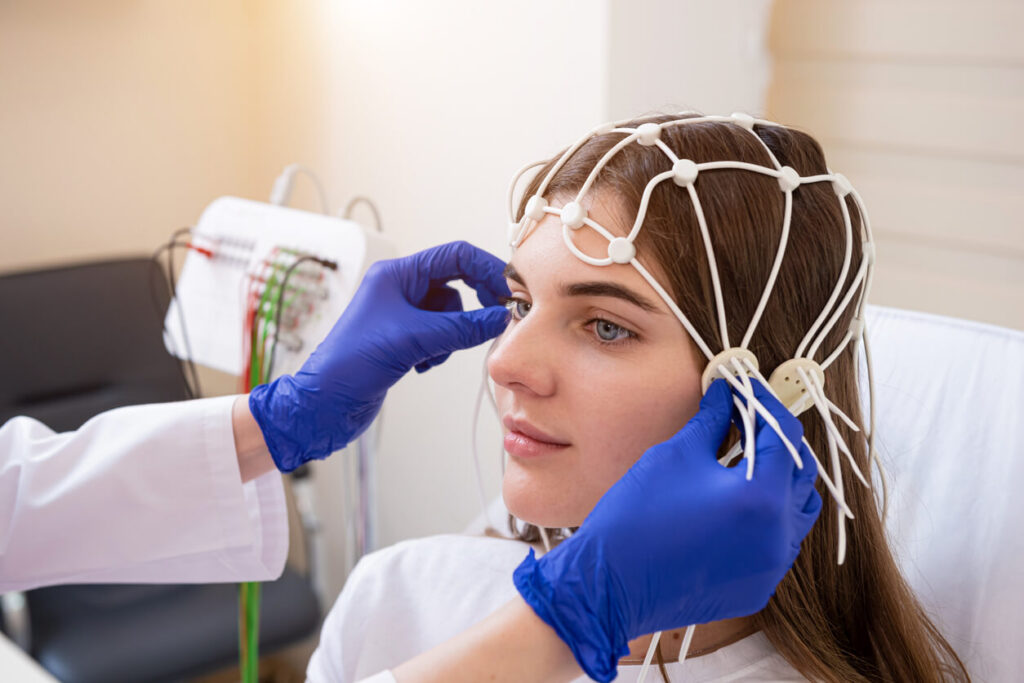
You sit in a reclining chair while a technician positions the coil against your scalp. Before your first session, your clinician determines your motor threshold. This is the precise stimulation level your brain responds to, so the treatment is calibrated to you specifically, not a generic setting.
During the session, you'll feel a tapping sensation on your scalp and hear rhythmic clicking sounds. Ear protection is standard. When it's done, you walk out and go about your day.
Side Effects
Common and usually short-lived:
- Headache
- Scalp discomfort
These typically occur during or shortly after a session and resolve on their own within the first week, according to NIMH's TMS safety guidance.
Rare but serious:
- Seizure: Reported at fewer than 1 per 60,000 sessions when treatment follows published safety guidelines, based on a review of 318,560 sessions across 714 active clinical sites
Seizure risk increases when safety parameters are exceeded or when patients have unscreened risk factors. This is a personal history of seizures, traumatic brain injury, or certain medications. Thorough screening before starting isn't optional; it's what keeps that risk low.
A Note on FDA Status
TMS devices have been FDA-cleared for depression since 2008. For ADHD, it's used off-label, which is outside the FDA's cleared indications. That's legal, common in psychiatry, and backed by a growing body of research, but it's a distinction you deserve to understand going in.
In sham-controlled trials, adults receiving active TMS showed greater improvements in ADHD symptoms than those receiving placebo stimulation. However, results vary depending on the protocol and the targeted brain region.
Who Is a Good Candidate for TMS?
TMS is a strong option to explore when other paths haven't worked. As one of the more studied alternatives to ADHD meds for adults, TMS tends to be most worth discussing with a psychiatrist for ADHD patients when:
- You've tried at least one stimulant and experienced intolerable side effects
- A medical condition makes stimulants unsafe, such as certain cardiac arrhythmias
- Non-stimulant options like Strattera (FDA-approved for ADHD) or Wellbutrin (sometimes used off-label) haven't provided sufficient relief
- You have co-occurring major depression or obsessive-compulsive disorder, both of which TMS is FDA-cleared to treat
- You have a history of substance abuse that makes stimulant prescribing inappropriate
- You prefer a drug-free approach for personal, occupational, or health reasons
Situations That Need Extra Evaluation
TMS isn't right for everyone and requires careful screening. Additional review is important if you have:
- Bipolar disorder (monitoring is needed for mood changes)
- Metal implants near the head (such as cochlear implants or certain aneurysm clips)
- A history of seizures or factors that increase seizure risk
- Traumatic brain injury, which may require individualized assessment
TMS also serves a different role than electroconvulsive therapy (ECT). The two treatments use different methods and are used in different clinical situations.
A comprehensive psychiatric and medical evaluation is essential before starting TMS. This helps confirm diagnosis, review safety factors, and determine whether TMS fits into a broader, personalized treatment plan.
What Should You Expect From a TMS Course?
Before treatment begins:
- You'll complete a comprehensive psychiatric evaluation
- Your provider confirms the ADHD diagnosis and reviews symptom patterns
- Medical and neurological factors are screened to ensure TMS is safe and appropriate
- The treatment plan is personalized rather than standardized
During the first weeks:
- Early sessions focus on getting used to the sensation and routine
- Most people find sessions feel familiar by the end of the first week
- Some patients notice improvements in focus, impulse control, or mental clarity within a few weeks
- Others may need the full course before noticing changes (response timing varies)
After the initial course:
- Some providers recommend booster sessions to help maintain progress
- Maintenance schedules for ADHD are not standardized
- Follow-up depends on symptom response and clinical judgment
- Providers often use validated rating scales to track progress before, during, and after treatment
One practical consideration is that insurance coverage for TMS is inconsistent, particularly for ADHD. Many plans cover it for depression, but not for ADHD specifically. Before starting, ask your provider which documentation may support a coverage request and which out-of-pocket options are available. Some providers offer payment plans or can connect you with financial assistance resources.
Stop Managing. Start Recovering. Serenity Can Help.
At Serenity Mental Health Centers, TMS isn't a last resort. It's part of a comprehensive, personalized evaluation process built around you. Since 2017, our team of experienced psychiatrists has helped adults across the country explore evidence-based treatment options for mental health conditions, including depression and anxiety. We evaluate adults for neuromodulation approaches, such as TMS, when clinically appropriate. Every patient works directly with a dedicated provider who takes the time to understand what hasn't worked before and why, so your next step is smarter, not just different.
With clinics nationwide and a commitment to staying at the forefront of mental health research, Serenity makes thoughtful, individualized treatment accessible, without the one-size-fits-all approach that's left so many adults feeling unheard. Whether you're just beginning to explore TMS or ready to take the next step, we are here to guide you from evaluation through every stage of your care.
Ready to explore your options at Serenity? Request your appointment today.